Home Blog Page 12

$21,000 fine for that? A driver denounces an injustice in Formula 1 that could also ruin fans’ enjoyment

0

Carlos Sainz denounces an excessive measure from the FIA: “We shouldn’t restrict our emotions on track.” His statement follows the FIA’s decision to tighten its tolerance regarding driver behavior.

The FIA wants to limit inappropriate language in F1, but this decision is ruffling many feathers. Carlos Sainz believes that imposing sanctions for swearing on the radio is excessive. While drivers should exercise restraint in press conferences, the FIA shouldn’t curb their spontaneity when they’re in the heat of the action on track.

Read more:

FIA Regulations deemed too strict

The FIA recently amended its Sporting Code to include penalties for remarks deemed inappropriate. This includes fines of up to €120,000 ($125,800), as well as points deductions or suspensions. WRC driver Adrien Fourmaux suffered the consequences, receiving a €10,000 fine for a simple swear during an interview. Moreover, that €10,000 (nearly $10,500) fine is doubled for F1 drivers. Carlos Sainz, who shared his opinion on the matter, would have faced a €20,000 ($21,000) penalty for the same infraction—a real injustice. When asked about this new rule, Sainz acknowledges that it is normal to maintain appropriate language during media interactions. But in his view, in-race radio is a completely different context. The adrenaline and pressure are such that censoring these exchanges would deprive the public of an authentic facet of F1.

AI in F1 soon? It would be historic, but one final obstacle remains—even with the millions of euros this company is willing to spend

A risk of losing the emotion of the sport,  not only Formula 1

The Spaniard insists that emotion is an integral part of the spectacle. The live radio messages allow fans to feel the tension and intensity of race moments. “If it’s not an insult to someone, just a word spoken in the heat of the moment, I don’t see what the problem is,” he explains. Sainz compares this situation to soccer: “If you put a microphone on a pitch, you’d hear far worse!” He fears that F1 will lose its authenticity if the FIA further restricts drivers’ freedom on the radio. Already, live radio messages are filtered with a delay to mask certain remarks. Going further could make the exchanges artificial and sanitized.

Sainz & Albon - © Williams Racing
Sainz & Albon – © Williams Racing

We have to find a balance according to Sainz

For Carlos Sainz, the key is to differentiate between contexts. “We must be exemplary in press conferences, but not restrict our reactions on track.” He points out that drivers already have to work within strict team instructions and highly structured communication. Allowing a bit more spontaneity on the radio would bring transparency and excitement to the fans. In motorsports, radio is one of the only mediums where you can hear everything a driver says, regardless of the context.

This article explores the FIA’s new regulations on inappropriate remarks in F1 and Carlos Sainz’s reaction to these restrictions. It highlights the importance of preserving the authenticity of on-track communications and the challenge of balancing public image with raw emotion.

Images: © Williams Racing

Every car is affected by this barely regulated toxic pollution – even electric vehicles aren’t spared

Car brakes pollute more than diesel—and nobody cares…

There’s a lot of talk about emissions from combustion engines and the impact of cars on air quality. But a recent American study has highlighted a problem that is discussed much less: the fine particles emitted by brake pads. According to researchers, these particles could be more toxic than diesel engine exhaust. And the worst part? They are hardly regulated.

Read more:

A problem affecting all cars, including Electric Vehicles

One might think that electrifying the vehicle fleet would solve the problem. But it’s not that simple. EV, although they use regenerative braking to reduce brake pad wear, are still affected. Their higher weight forces them to use their brakes more when they need to slow down abruptly, generating even more fine particles. In a way, it’s crazy that electric cars might pollute more than internal combustion engine cars… A study by the University of Southampton analyzed several types of brake pads and their impacts on human health. The results are concerning: car brakes release particles that can be more toxic than diesel engine emissions.

The United States overtakes China in the electric vehicle market with this 6000°F plasma technology that will boost battery production

Toxic components in brake pads

One of the worrying aspects of this study is the materials used in modern brake pads. In the past, asbestos was commonly used for its thermal properties, but its ban pushed manufacturers to turn to other materials like copper. The problem? The copper particles released into the air are linked to increased risks of cancer, asthma, and chronic lung diseases. Researchers found that asbestos-free organic brake pads, widely used in the United States because of their affordable cost, are actually the most toxic for the lungs. Bad news indeed…

U.S. regulations still too weak

Unlike emissions from combustion engines, the particles from braking are hardly regulated. Some U.S. states like California and Washington have enacted laws to limit the amount of copper in brake pads, but these measures were implemented mainly to protect aquatic wildlife, not to fight air pollution. In Europe, the Euro 7 standard, set to take effect in 2026, will begin to limit these emissions—but only on new vehicles. The millions of cars already on the road will continue to produce these toxic particles without restriction, which is a real problem given the vast number of vehicles in the current fleet.

Unlike emissions from combustion engines, the particles from braking are hardly regulated.

A potential solution thanks to supercars?

In the end, it’s pretty funny to imagine that supercars and hypercars, with their carbon-ceramic brakes, might pollute less than a “standard” car. But don’t be fooled—these types of brakes also release fine particles. The study doesn’t specify whether they contain copper, but they would be far too expensive to install on normal cars anyway. For your information, a set of four carbon-ceramic brakes costs around 8,000 to 15,000 dollars depending on the manufacturer…

This article explores the little-known pollution from our cars’ brake pads, which could be more harmful than exhaust gases. While electric cars don’t completely solve the problem, regulations remain lagging, leaving a major source of pollution largely ignored.

The very first 100% electric luxury SUV has already been snapped up by 48,000 lucky buyers and promises to take British luxury to places it’s never been before

Range Rover is about to write a new chapter in its history with a 100% electric version.

A bold bet for an iconic SUV whose off-road capabilities and luxury are at the heart of its DNA. With over 48,000 customers already on the waiting list, the first prototypes were undergoing extreme tests in the deserts of the United Arab Emirates a few weeks ago. But is this transformation really a good idea for a vehicle in this category?

Read more:

An electric Land Rover SUV promising unprecedented performance

Land Rover assures that its Range Rover Electric will not sacrifice the performance of its combustion counterparts. Thanks to an optimized weight distribution with batteries placed under the floor, the SUV is expected to offer exemplary handling and unprecedented off-road capabilities. Engineers have developed an intelligent torque management system designed to ensure optimal traction on all types of terrain, including the most unstable surfaces like sand. During testing, the electric Range Rover demonstrated that it could climb a 328-ft slope in the desert, proving that it meets the range’s standards. And it’s true—the advantage of electric off-roaders lies in the instant availability of torque from electric motors. There’s no need to rev the engine (which is impossible anyway), so the wheels don’t spin.

With these features, Land Rover aims to make the Range Rover Electric the most high-performing luxury electric SUV in the world. But while the theory is promising, market realities could present some challenges.

During testing, the electric Range Rover demonstrated that it could climb a 328-ft slope in the desert - © Land Rover
During testing, the electric Range Rover demonstrated that it could climb a 328-ft slope in the desert – © Land Rover

Is electric really suited for this type of vehicle?

While electrifying a luxury SUV may seem logical for urban and everyday use, the market is showing signs of skepticism. Many manufacturers, such as Porsche and Mercedes, are slowing their transition to 100% electric in the face of a public that is less enthusiastic than expected. One of the main obstacles remains weight. A hybrid Range Rover already exceeds 2.6 tons. With an all-electric version, it could approach 3 tons—a striking figure that raises questions about handling and energy consumption. Such high weight could impact dynamic performance and range, even with a large battery.

A risky, but well-considered bet

For some high-end and luxury manufacturers, electrification makes sense. Rolls-Royce, for example, justified creating its Spectre (an electric coupe) by explaining that most of its customers drive only a few kilometers a day and therefore don’t need enormous range.
In the case of the Range Rover, the argument may hold, especially for an urban clientele that primarily seeks comfort and quiet. It remains to be seen whether Land Rover can truly reconcile luxury, performance, and electrification without compromising the DNA of its flagship model.

Only 5 in the world! No SUV from this famous luxury brand has ever commanded such a high price and such exclusivity

This article explores the transition of the Range Rover to a 100% electric powertrain, highlighting the technical challenges and market expectations. Between technological advances and constraints related to weight and range, the future of the British SUV looks as ambitious as it is risky.

Images: © Land Rover

Formula 1 has a major problem that directly affects fans, and the trend isn’t looking up

0

The popularity of Formula 1 has exploded in recent years, attracting a new wave of fans thanks to the Netflix era and increasingly intense rivalries.

But this surge has also led to a worrying trend: discussions about F1 seem to be becoming increasingly toxic. A study conducted by Buzz Radar reveals a marked increase in negative exchanges within the fan community, with a trend that shows no signs of slowing down—not to mention the outbursts in the grandstands at circuits.

Read more:

An increasingly tense climate in Formula 1

While social media has allowed fans to get closer to the sport and share their passion, it has also become the stage for heated debates and even personal attacks. Buzz Radar’s study, which analyzed 100 million messages posted by 247,000 accounts between 2016 and 2024, shows that the share of negative comments has more than doubled, rising from 8% in 2016 to 20% today. Even the drivers themselves are not spared by this wave of negativity. Max Verstappen, Lewis Hamilton, Carlos Sainz, as well as former paddock figures like Nicholas Latifi and Michael Masi, have been hit by vicious campaigns, including death threats following the controversial 2021 season finale. This phenomenon is increasingly concerning the sport’s authorities, to the point that the FIA is considering harsher penalties for harmful behavior.

Netflix is once again betting on Formula 1 to skyrocket its subscriber count, but the bill will far exceed $90M

Topics that divide the F1 fans

Rivalries on the track are not the only sources of tension. FIA regulations, sometimes seen as inconsistent, are a major cause of frustration, as are the decisions made by race stewards that can change the outcome of a Grand Prix. The controversial finish of the 2021 championship is a perfect example—it continues to fuel heated discussions more than three years later. The evolution of the sport, with the arrival of hybrid cars, format changes like Saturday sprints, and the issue of the budget cap, also crystallizes these tensions. For some longtime fans, these changes distort the sport, while for others, they are necessary to ensure a sustainable future for F1.

A trend that shows no signs of slowing down

The algorithms used in the study predict another increase in toxicity within the next 18 months, which could pose a real problem for Formula 1 and its image. While passionate debates have always been part of the sport, the rise of online hate could discourage new fans from engaging and even affect the drivers and teams.

Max Verstappen & Alex Albon - © Williams Racing
Max Verstappen & Alex Albon – © Williams Racing

Incidents even on the circuits

Beyond social media, it’s the stands that have been directly affected. Remember the outbursts in Mexico that led to a general brawl, or that smoke grenade that was ignited and then thrown near the track? Not to mention the incident at Silverstone, where a group of people interfered on the circuit while F1 cars were preparing in their warm-up area. It’s unfortunate, but Formula 1 has a real problem with behavior, much like many other sports. If any evidence were needed, it shows that it is, above all, a matter of passion—both positive and negative.

This article explores the rise of toxicity within the F1 community, highlighting the growing tensions on social media and the topics that divide fans. Buzz Radar’s study suggests that the phenomenon is worsening, raising questions about the impact of this negativity on the sport and its stakeholders.

Images: © Scuderia Ferrari / © Williams Racing

China challenges U.S. influence in Latin America by taking control of one of the planet’s most sought-after resources for EV production: lithium

BYD’s game-changing move: secures lithium mines and sets sight on solid-state batteries by 2027.

In a bold stride toward dominating the global electric vehicle (EV) market, China’s BYD has clinched lithium mining rights in Brazil and revealed advancements in solid-state battery technology, eyeing a revolutionary shift in EV production by 2027.

Read more:

Strategic lithium acquisition in Brazil

BYD, already the world’s leading electric vehicle manufacturer, has expanded its resource acquisition strategy by securing rights to mine lithium on two plots of land in Brazil. These plots, spanning a combined area of 852 hectares, are nestled in the heart of Brazil’s “Lithium Valley” in the municipality of Coronel Murta, Minas Gerais. This region is renowned for its rich lithium deposits, a critical component for battery manufacturing.

The main flaw of electric cars is FINALLY going to be fixed thanks to this discovery that will enable the creation of much more durable batteries.

Proximity to production: a logistical advantage

The mining sites’ strategic location, approximately 512 miles from BYD’s upcoming EV factory in Bahia state, Brazil, positions BYD advantageously. This proximity is expected to streamline the supply chain, reducing costs and enhancing production efficiency for BYD, which plans to churn out 150,000 electric vehicles annually from this new factory.

Vertical integration: controlling the supply chain

BYD’s move is emblematic of a broader industry trend toward vertical integration, where companies control the production process from raw materials to finished products. BYD is not new to this approach, having previously engaged in lithium mining within China and pursued lithium projects in Chile. This latest venture in Brazil further solidifies its commitment to controlling critical elements of the EV supply chain.

Breakthrough in solid-state battery technology

Parallel to its mining endeavors, BYD has made significant headway in solid-state battery technology, a development poised to transform the EV landscape. At a recent summit in China, Sun Huajun, Chief Technology Officer of Shenzhen BYD Lithium Battery, announced the successful production of 60Ah all-solid-state batteries from a pilot line.

Timeline for innovation: from pilot to production

BYD plans to commence mass demonstrations and installations of these batteries around 2027, with ambitions for large-scale commercialization slated for the early 2030s. Solid-state batteries are heralded for their superior energy density, safety, and longevity compared to traditional lithium-ion batteries, promising to enhance the efficiency and appeal of electric vehicles significantly.

Industry-wide implications and collaborative efforts

BYD’s advancements are part of a larger wave of innovation across the industry. Companies like Hyundai and U.S.-based Anthro Energy are also making strides in solid-state battery technology, each contributing to a rapidly evolving marketplace. Hyundai plans to integrate these batteries into its EVs by 2025, while Anthro Energy is developing an innovative battery with a transformable electrolyte.

China challenges U.S. Influence in Latin America with lithium play

BYD’s lithium acquisition in Brazil marks more than just a corporate expansion—it signals China’s growing foothold in a region traditionally dominated by U.S. influence. As lithium becomes an increasingly strategic resource, crucial for energy security and technological supremacy, China’s presence in Brazil could escalate tensions between the two superpowers. Washington has long considered Latin America within its sphere of influence, and Beijing’s latest move disrupts this geopolitical balance. With global demand for lithium surging, this deal could spark concerns in Washington over China tightening its grip on critical mineral supplies, adding a new dimension to the already complex U.S.-China rivalry.

This 218-year-old technology has completely won over Toyota and promises three times the efficiency of electric vehicles

This surge in technological advancements and strategic resource management by BYD and its peers signals a transformative era in electric vehicle production, emphasizing efficiency, sustainability, and performance. As these technologies mature, they are set to redefine mobility, underscoring a significant shift towards more sustainable and advanced transportation solutions.

Source: https://carnewschina.com/2025/02/15/byd-will-start-mass-installation-of-all-solid-state-batteries-around-2027-company-cto-says/

An American receives one of 599 Ferrari V12 Hypercars, but this small detail makes it absolutely unique in the world

If the Ferrari Daytona SP3 is already exclusive enough, this model from the Tailor Made program is a one-of-a-kind in the world.

Among the many Ferraris leaving Maranello each year, some immediately catch the eye. That’s the case with this purple Daytona SP3, recently delivered by an American dealer in New Jersey to a passionate collector. This unique model, part of the Tailor Made program, sports a spectacular purple hue and an equally bold interior. But beyond its appearance, this hypercar pays homage to Ferrari prototypes from the 1960s with an exceptional naturally aspirated V12.

Read more:

A Daytona SP3 that stands out

Unlike the many red Ferraris that fill collections, this Daytona SP3 takes a much more original approach. Thanks to the Tailor Made program, its owner was able to choose a deep purple color—a shade rarely seen on a modern Ferrari. Even details like the wheel center caps, grilles, and carbon engine covers have been matched to offer a harmonious and exclusive finish. Inside, the customization doesn’t stop there. The cabin features elements in bright blue Alcantara, as a nod to the brand’s iconic race cars. The overall effect creates a unique ambiance that matches the prestige of this model, produced in only 599 units. The Daytona SP3 is already a very exclusive car, but with such a configuration, it becomes one-of-a-kind in the world.

Daytona SP3 - © Ferrari of Central New Jersey
Daytona SP3 – © Ferrari of Central New Jersey

Why is the Daytona SP3 so insane?

The Daytona SP3 is the second edition in the Icona series, an ultra-exclusive series launched by Ferrari with the Monza SP1 and the SP2. Beneath this sculpted body lies a true mechanical gem. The Daytona SP3 is equipped with a 6.5-liter naturally aspirated V12, producing 840 horsepower and capable of reaching 9,500 rpm. It is simply the most powerful engine ever installed in a non-hybrid-assisted Ferrari. This engine, derived from that of the 812 Competizione, delivers a unique sound and dynamic experience. Paired with a dual-clutch F1 gearbox, it allows for blistering acceleration, with a 0-60 mph time in just 2.85 seconds. But more than raw performance, it’s the emotion it delivers that makes it so special, recalling the golden era of motorsport.

Daytona SP3 - © Ferrari of Central New Jersey
Daytona SP3 – © Ferrari of Central New Jersey

A design dedicated to aerodynamics

Ferrari has taken a radical approach to aerodynamics with the Daytona SP3. Unlike other hypercars or supercars, it does not feature any active elements, relying solely on sculpted surfaces and optimized diffusers to generate up to 530 lbs of downforce at high speeds. Competition-inspired details are found everywhere on the body: modernized retractable headlights, side vents that optimize airflow, and an elevated exhaust that releases an ultra-efficient diffuser. All of this provides exemplary stability, even at speeds above 212 mph. And what about its design… Absolutely stunning, don’t you think?

He saves millions on his Supercar purchase and ends up with a one-of-a-kind model in his country

This article explores the Ferrari Daytona SP3 in an exceptional configuration delivered in New Jersey, combining advanced personalization with radical performance. With its naturally aspirated V12 and race-inspired design, it embodies the pure Ferrari DNA, intended for collectors and enthusiasts in search of exclusivity.

Images: © Ferrari of Central New Jersey

15 years after its debut, this legendary V10 Supercar is set to welcome its replacement—but will it be as exciting?

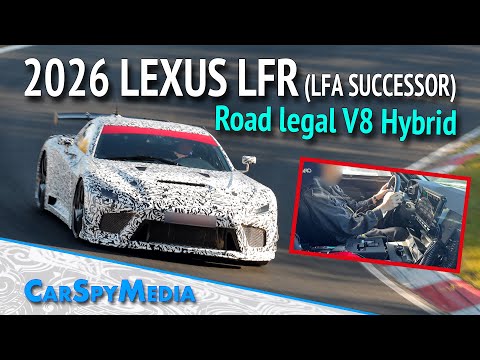
Lexus isn’t done with supercars yet, and it’s ready to make a big impact with a hybrid supercar boasting over 900 horsepower.

After making an impression with the LFA and its incredible naturally aspirated V10 in 2010, the Japanese brand is preparing its comeback with an all-new model that promises to be radically different. Named the LFR, this future machine adopts a hybrid powertrain, and early reports suggest it could be one of the most powerful in its class.

Read more:

No V10, but an impressive hybrid engine

Forget the roaring V10 of the LFA—Lexus is completely changing its approach with the LFR. Under its long hood, you’ll find a 4.0-liter twin-turbo V8 paired with a hybrid system that pushes total power beyond 900 horsepower. This is a true leap forward for the brand, which has never offered a model as powerful in its lineup. Why such a change? Lexus is following the trend set by new environmental standards and the energy transition. The brand is betting on hybridization to improve performance while reducing emissions—a compromise that seems to be taking hold in the world of supercars, where even Ferrari and McLaren now adopt similar architectures. But don’t worry, when you consider that they hired acoustics professionals to produce the best possible sound on the LFA, it’s safe to bet that the LFR will deliver a very beautiful sound.

He saves millions on his Supercar purchase and ends up with a one-of-a-kind model in his country

An aggressive design inspired by racing

The first prototypes spotted at the Nürburgring show a car with an extremely sporty look. The LFR takes on the design cues of great front-engine supercars with a long hood reminiscent of models like the Mercedes-AMG GT or the legendary SLS. But that’s not all—some parts of its design evoke the LFA, notably the rear air vents and the overall shape of the chassis. There are also a few details borrowed from race cars, suggesting that Lexus might offer a version tailored for the track. There’s already talk of a more radical version with side exhausts and extreme aerodynamics. Clearly, we’re lacking models with side exhausts, don’t you think?

A debut in the market and in competition?

Lexus seems determined not to repeat the mistake of the LFA, which was produced in only 500 units. This time, the LFR could be sold without production limits, allowing it to compete with models like the Mercedes-AMG GT or the Aston Martin Vantage in the supercar market. Its price is estimated at around 200,000 dollars, an aggressive positioning for a car that could offer more power than some European hypercars. And that’s not all: Toyota also plans a racing version to be entered in the WEC as early as 2026, under the guidance of the Gazoo Racing division—an announcement that shows the brand is taking this project very seriously.

The LFA on track - © Lexus
The LFA on track – © Lexus

This article explores Lexus’s return to the supercar universe with the upcoming LFR, a hybrid model boasting over 900 horsepower. With an aggressive, race-inspired design, this car could well become one of the most impressive in its class while ushering in a new era for the Japanese brand.

Images: © Lexus

This 218-year-old technology has completely won over Toyota and promises three times the efficiency of electric vehicles

Toyota is renewing its bet on hydrogen with a technology that could change everything…

While the hydrogen vehicle market is struggling to take off, Toyota isn’t giving up. Despite a sharp decline in Mirai sales, the Japanese brand continues to believe in this technology and is unveiling a third generation fuel cell that promises more range, better durability, and lower costs compared to lithium-ion battery electric cars.

Read more:

A more efficient and accessible battery technology

Toyota has focused on three major improvements with this new generation of hydrogen fuel cells: greater range, extended lifespan, and reduced production costs. According to the brand, energy efficiency has been increased by 20%, meaning that vehicles equipped with this technology could travel up to 480 miles on a full tank, compared to about 402 miles for the current Toyota Mirai, their hydrogen model. This breakthrough could make hydrogen a more credible alternative to battery electric vehicles, which are often criticized for their limited range on long trips. Another strong point of this new system is its increased robustness. Toyota claims that this fuel cell now has a durability comparable to diesel engines, while requiring less maintenance—an essential feature for fleets of commercial vehicles, buses, or even trains that need reliable and enduring solutions. Finally, the brand has worked on simplifying the manufacturing process, which should reduce the cost of hydrogen vehicles. If these promises are fulfilled, this technology could become much more accessible to the general public.

If no country reacts, this Korean automaker will become the leader in Electric Vehicles thanks to a world-first: solid-state battery production

Hydrogen: A risky but necessary bet?

Despite these advances, hydrogen vehicle sales remain very low. In 2024, Toyota sold only 1,778 Mirai units worldwide, a drop of nearly 56% compared to the previous year. This figure highlights the many challenges facing the hydrogen sector. The main hurdle is the lack of infrastructure. Unlike electric vehicles, which can be charged from a standard home outlet, hydrogen cars require specific stations, which are still very rare outside Japan, South Korea, and California. However, Toyota is not limiting this technology to passenger cars. The company is also developing industrial and commercial applications: trucks, buses, trains, and even stationary generators. For these sectors, hydrogen represents a more viable solution, as it offers great range and fast refueling, where electric batteries still show limitations.

In 2024, Toyota sold only 1,778 Mirai units worldwide - © Toyota
In 2024, Toyota sold only 1,778 Mirai units worldwide – © Toyota

An uncertain future, but huge potential

Toyota plans to officially unveil this new hydrogen fuel cell at the International Hydrogen & Fuel Cell Expo in Tokyo. The first vehicles and equipment equipped with this technology could appear as early as 2026 in Japan, Europe, North America, and China. While the widespread adoption of hydrogen remains a challenge, technological advances and falling costs could gradually allow it to find a place alongside battery electric vehicles. It remains to be seen if governments and industry will follow Toyota in this vision of a more diverse propulsion future, with that famous hydrogen car that was invented in 1807.

This article explores Toyota’s continued commitment to hydrogen despite low sales and a limited market. With a third-generation fuel cell that is more efficient, more durable, and cheaper to produce, the Japanese brand hopes to make this technology more viable for vehicles and industrial applications.

Images: © Toyota

You underestimate this 671-hp supercar – it easily rivals the Ferrari hailed as the best in years

Why is the McLaren Artura so underrated?

In the world of supercars, some models immediately capture the public’s attention, while others remain in the shadows despite their undeniable qualities. The McLaren Artura falls into the latter category. It is, however, a pioneer for the British brand: the first McLaren with a plug-in hybrid powertrain in a mass-produced model. But then, why does it remain so little known and should it be bought?

Read more:

A McLaren true to the brand’s DNA

The Artura is not just another addition to the lineup—it represents a major evolution for McLaren. Its chassis is based on the brand’s all-new McLaren Carbon Lightweight Architecture (MCLA), specially designed for its hybrid models. This technical choice helps to compensate for the extra weight of the electric motor while preserving the lightness, a key element of McLaren’s DNA. Its design also adheres to the brand’s fundamentals: clean lines, optimized aerodynamics, and a driver-focused cockpit. Inside, everything is designed for driving: a minimalist dashboard, controls within easy reach, and a smooth interface with Apple CarPlay and Android Auto.

McLaren didn’t simply add an electric motor to follow a trend. The Artura was conceived from the start as a high-performance hybrid, offering instant throttle response and constant torque thanks to its 95-horsepower electric motor. The result is an ultra-responsive driving experience, while still being suitable for everyday use with a 100% electric range of 18.6 miles.

Artura - © McLaren
Artura – © McLaren

A hybrid V6 engine built for performance

While some hybrid models focus primarily on energy efficiency, the McLaren Artura remains a supercar at heart with performance as its goal. Its 3.0-liter twin-turbo V6 produces 577 horsepower, and when combined with the electric motor, total power reaches 671 horsepower and 720 Nm of torque. With a 0-60 mph time of just 3 seconds and a top speed of 205 mph, it delivers performance on par with the best McLarens, while also providing an extra level of driving pleasure. Its electric motor makes up for the slight lack of low-end torque in the V6, allowing for instantaneous acceleration both in the city and on the track.

Another innovation: the absence of a mechanical reverse gear. Instead, the electric motor handles that, which has allowed McLaren to further lighten the 8-speed dual-clutch transmission. This attention to detail reflects McLaren’s commitment to staying true to its philosophy of lightness and performance. That said, I have no idea what happens when you run out of battery…

Artura - © McLaren
Artura – © McLaren

The McLaren Artura: A true supercar

While the Ferrari 296 GTB is often considered the benchmark in this category in addition to being the best Ferrari in recent years, the Artura offers a different, yet equally appealing, approach. First, it is also lightweight, weighing in at 3,302 kg compared to about 3,240 kg for the 296 coupe version (the convertible is heavier). Add to that hydraulic power steering, which gives it a more direct and engaging feel in dynamic driving. Secondly, its price is more accessible. With a starting price of around $250,000, it remains well positioned compared to the Ferrari, which easily exceeds $315,000 with options. For a buyer seeking a high-performance hybrid supercar that is light and true to a racing brand’s DNA, the Artura is a very compelling choice.
McLaren also offers numerous customization options through its MSO (McLaren Special Operations) program, allowing customers to configure their car with unique colors and exclusive finishes.

$2.7 million for this? A buyer gets this Hypercar not to drive, but for a completely unprecedented use

This article explores the reasons why the McLaren Artura is underrated and why it should receive more attention thanks to its undeniable qualities. Lightweight, high-performing, and equipped with a perfectly integrated hybrid powertrain, it embodies the future of supercars while staying true to McLaren’s DNA. A model that definitely deserves more recognition.

Images: © McLaren

F1 2025: No 23-year-old driver has ever come this close to winning the F1 World Championship with only two seasons under his belt

0

Oscar Piastri, the young McLaren driver, is no longer the quiet rookie discovering Formula 1—he’s determined to become a great champion.

After two solid seasons with the British team, the Australian enters the 2025 Formula 1 season with a clear ambition: to fight for the world title. His quick adaptation and his first Grand Prix wins last year have given him confidence, and he now feels ready to compete with Max Verstappen as well as his teammate Lando Norris.

Read more:

Oscar Piastri already at his prime at McLaren?

From his early days at McLaren, Oscar Piastri impressed with his maturity and ability to adapt. His first success in Hungary, followed by a brilliant win in Baku, confirmed his potential and racing intelligence. However, things haven’t always been easy. On some weekends, he struggled to find the right pace, especially during qualifying where Norris often had the advantage. Aware of these small shortcomings, Piastri has focused on better preparation this winter. More time in the simulator, a detailed analysis of his performance, and work on his consistency should help him become more regular. He knows that to contend for the title, it’s not enough to be fast in a few races, but rather to consistently deliver solid results throughout the season. And Piastri is well supported, notably by Mark Webber, his agent and fellow countryman who raced in F1 in the 2010s.

Netflix is once again betting on Formula 1 to skyrocket its subscriber count, but the bill will far exceed $90M

McLaren World Champion: An opportunity to seize in 2025

McLaren made a spectacular leap in 2024, moving from a mid-grid team to a true challenger for Red Bull and constructors champion. The MCL39, which Piastri has just discovered, might be the car that will allow him to take a step forward. The British team has invested heavily in its development and reliability, and the first tests seem to confirm the hopes placed in this single-seater. With a more competitive package than ever, every detail will count. Piastri knows that even if McLaren isn’t the fastest car in every race, maximizing points on slower weekends will be crucial to stay in the title fight. A lesson he learned well after watching Norris battle Verstappen last year.

Lando Norris - © McLaren media
Lando Norris – © McLaren media

Beware the sibling rivalry between Norris and Piastri

If Piastri aims for the title, he must first assert himself against Norris, who remains the natural team leader after several seasons at McLaren. Their rivalry could become one of the most followed battles of the season, as the two drivers are very close in performance.
But the Australian is not easily intimidated. He has already proven he can compete with Norris on certain circuits, and he is convinced that 2025 will be the year he takes it to the next level. He knows that every hundredth of a second will count and that the balance of power within the team could change at any moment.

This article explores the growing ambition of Oscar Piastri, who feels ready to challenge Max Verstappen and Lando Norris in the F1 world champion title fight. With a rapidly progressing McLaren and a more rigorous preparation, the Australian wants to turn his potential into concrete results and establish himself as a serious contender for the world championship.

Images: © McLaren media