Home Blog Page 21

One of the best pieces of news of the year has already dropped, and it concerns the world’s most famous SUV: the new Defender

While many automakers are diving headfirst into electrification, Land Rover is taking a more cautious approach with its iconic Defender.

Mercedes-Benz has already made the leap with its legendary G-Class, the Defender’s top competitor, so why isn’t a fully electric Defender planned for this generation? Here’s a look at the reasons behind this decision and what it means for the future of Land Rover’s off-road champion

Read more:

Current architecture: current Defender can’t be electrified

Since its launch in 2019, the L663-generation Land Rover Defender has won over off-road enthusiasts with its ruggedness and capabilities, even though it’s more commonly seen in urban settings than on winding trails. However, integrating an electric powertrain into this chassis presents a major challenge: space. According to Lennard Hoornik, Chief Commercial Officer of Jaguar Land Rover (JLR), the current D7x platform is not suitable for housing a battery and electric motor without compromising performance. The issue goes far beyond simply adding batteries. The Defender’s structure is designed to maximize off-road performance, particularly through the configuration of its axles and other mechanical components. Altering this balance to accommodate an electric drivetrain would require a complete overhaul—something that’s not on the horizon for the current generation.

The current D7x platform is not suitable for housing a battery and electric motor - © Land Rover
The current D7x platform is not suitable for housing a battery and electric motor – © Land Rover

An electric defender will have to wait for a new generation

Jaguar Land Rover has committed to offering electric models across all its ranges, including Range Rover, Discovery, Jaguar, and Defender. However, an electric Defender will have to wait for what Hoornik describes as a “significant step in evolution” for the model. In other words, it’s likely to require a next-generation release or a new dedicated platform to make this a reality. Land Rover has two options: develop a standalone electric Defender or wait until the next generation to integrate an electrified platform. The latter seems more likely but won’t happen until the next decade. Hybrid powertrains are currently driving sales, and this generation is so successful that it’s far from being discontinued anytime soon.

This generation is so successful that it’s far from being discontinued anytime soon - © Land Rover
This generation is so successful that it’s far from being discontinued anytime soon – © Land Rover

A thoughtful electrification strategy

While Land Rover takes its time with the Defender, the brand is actively working on other electric models. The electric Range Rover, for example, is on the verge of being unveiled, strengthening Land Rover’s presence in the premium electric vehicle market. The company’s strategy is to maintain the DNA of its models while meeting market demands for sustainable and high-performing options. For the Defender, known for its authenticity and toughness, sacrificing its off-road capabilities for the sake of marketing would be a mistake. Land Rover is choosing to wait until it can deliver a product that meets its high standards, even if it means letting competitors like the Mercedes-Benz electric G-Class get ahead. That said, whether the market’s excitement for electric off-roaders is as strong as predicted remains to be seen.

Fully autonomous cars on our roads by 2025? A decisive innovation is expected to equip half of new vehicles this year

This article explores why an electric Land Rover Defender won’t be available in the current generation, the technical challenges of electrifying the model, and the brand’s strategy to integrate EVs while staying true to its DNA. With a forward-looking vision, Land Rover is ensuring that an electric Defender will honor its storied legacy.

Images: © Land Rover

Fully autonomous cars on our roads by 2025? A decisive innovation is expected to equip half of new vehicles this year

The revolution in mobility is advancing rapidly, and the concept of autonomous vehicles is no longer a futuristic dream confined to science fiction.

Thanks to the swift progress of Intelligent Transportation Systems (ITS) and the growing integration of 5G networks, these self-driving vehicles are getting closer to hitting our roads. But what challenges, technological innovations, and key players are driving this transformation? Let’s dive in.

Read more:

5G and connected cars: An essential symbiosis

The role of 5G in the development of autonomous vehicles is critical. This ultra-fast network enables instant communication between vehicles, infrastructure, and control centers. Known as C-V2X (Cellular Vehicle-to-Everything), this technology surpasses the limitations of older systems like DSRC (Dedicated Short-Range Communications). With high transmission speeds and low latency, connected cars can analyze their surroundings in real time, anticipate dangers, and adapt accordingly. Countries like China are leading the way with massive adoption of C-V2X, which is expected to equip 50% of new vehicles by 2025. Companies like Qualcomm and Cohda Wireless are continuously innovating to optimize these communications. These technological advancements not only enhance safety but also improve traffic management, reducing congestion and accidents.

5G is expected to equip 50% of new vehicles by 2025.

Lidar: The eyes of autonomous vehicles

Autonomous vehicles cannot rely solely on connectivity; they also need to “see.” This is where Lidar (Light Detection and Ranging) comes in—a laser sensor system capable of creating 3D maps of the environment. Combined with technologies like cameras and radars, Lidar plays a key role in Advanced Driver Assistance Systems (ADAS), enabling vehicles to detect and avoid obstacles with unmatched precision. It’s such a promising technology that it even powers some of the latest cutting-edge phones. Companies like Velodyne, Luminar, and Waymo are competing to improve the range, accuracy, and affordability of these sensors. However, these technologies remain costly and are sensitive to adverse weather conditions like fog and rain, driving the industry to explore more robust alternatives. For now, Lidar remains indispensable for ensuring reliable autonomous navigation.

A heartbreaking waste: this American startup had the potential to lead electric transportation, but a staggering debt shattered its dreams

The challenges of mass adoption

Despite impressive technological advancements, several obstacles still hinder the large-scale deployment of autonomous vehicles. Regulation remains a significant hurdle, as lawmakers must balance innovation with safety. Additionally, liability in accidents involving driverless cars sparks debates: who is responsible in such cases? From a technical standpoint, the seamless integration of autonomous vehicles into mixed traffic (traditional and self-driving cars) requires rigorous testing. Finally, the high costs of technologies like Lidar and 5G networks slow down democratization, limiting these innovations to high-end vehicles or industrial fleets.

This article explores:

  • How 5G is transforming connectivity for autonomous vehicles.
  • The crucial role of Lidar in vehicles’ environmental perception.
  • The regulatory and economic challenges slowing their widespread adoption.

With major technological advancements and massive investments, the future of autonomous vehicles appears promising. However, their arrival on our roads will depend as much on technology as on the economic and political decisions made in the coming years.

Source: Research and Markets

A heartbreaking waste: this American startup had the potential to lead electric transportation, but a staggering debt shattered its dreams

Despite a promising start and prestigious contracts, Canoo, an American start-up specializing in electric utility vehicles, has officially filed for bankruptcy.

Canoo was meant to compete with giants like Tesla while offering a more rugged touch. Unfortunately, the company, which aimed to revolutionize transportation with bold technical innovations, failed to realize its ambitions in a highly competitive market.

Read more:

A bold vision for a versatile product

Founded in 2017, Canoo developed a modular electric platform that represented a genuine engineering achievement. All major components—batteries, motors, and management systems—were integrated into a compact base, allowing various body styles to be added as needed. This concept was designed to cater to a range of applications, from delivery vans to recreational vehicles. Among its flagship products, the Canoo Lifestyle Vehicle stood out with a futuristic design and features ideal for urban transportation. The Canoo Pickup Truck, boasting a rugged look and modularity, targeted small businesses and tradespeople. Lastly, the Canoo Multi-Purpose Delivery Vehicle, designed for deliveries, offered optimized cargo space and customizable options to meet modern logistical demands. These vehicles were offered exclusively through a subscription model, an innovative approach that included maintenance, insurance, and software updates. However, this formula failed to attract enough customers to offset the high development and production costs.

Canoo developed a modular electric platform that represented a genuine engineering achievement - © Canoo
Canoo developed a modular electric platform that represented a genuine engineering achievement – © Canoo

Prestigious contracts but uncertain execution

Despite its innovative concepts, Canoo faced numerous challenges. The company secured notable contracts, including one with NASA for astronaut transport and another with the U.S. Department of Defense. In 2021, a partnership with Nvidia aimed to integrate advanced autonomous driving and driver-assistance systems into its vehicles. However, the start-up was hindered by unclear strategic decisions. It wavered between producing its vehicles in-house and outsourcing to third-party manufacturers. This indecision caused delays and inflated costs. Additionally, the departure of several key executives, including its CTO and CFO, further destabilized the company.

The company secured notable contracts, including one with NASA for astronaut transport - © Canoo
The company secured notable contracts, including one with NASA for astronaut transport – © Canoo

A fall hastened by competition and lack of funds

By 2023, financial troubles had intensified. Canoo laid off employees, furloughed part of its workforce, and shuttered its Oklahoma factory. While the company desperately sought foreign investment, negotiations failed to materialize. At the beginning of 2024, Canoo declared bankruptcy, revealing $164 million in debt while its assets were valued at just $122 million. The electric vehicle market, already dominated by established players like Tesla, left little room for Canoo. Despite its original ideas, its products failed to compete with rivals offering more attractive pricing and superior technical performance. Canoo joins other once-promising start-ups like Fisker and Lightyear, casualties of a fiercely competitive industry.

2 Ferraris crashed in one month: with only 478 hp, why is the F40 so dangerous?

This article examines the rise and fall of Canoo, a start-up that promised to revolutionize electric transportation. With innovative but poorly positioned products, prestigious yet insufficient contracts, and disastrous strategic decisions, the company highlights the immense challenges new entrants face in a saturated market.

Source & images: Canoo

2 Ferraris crashed in one month: with only 478 hp, why is the F40 so dangerous?

This is already the second Ferrari F40 crash in 2025, following the one involving F1 driver Lando Norris’s model.

The Ferrari F40, an iconic supercar of the 1980s, is renowned for its extreme performance and total lack of driver aids. But this explosive combination can quickly turn into a nightmare. A recent crash in the UK serves as a stark reminder that this icon is not meant for careless drivers or unpredictable weather conditions.

Read more:

Why is the Ferrari F40 so hard to drive?

The F40 is more than just a Ferrari; it’s a piece of history. Launched in 1987 to celebrate Ferrari’s 40th anniversary, it was the last car overseen by Enzo Ferrari himself. Its 2.9-liter twin-turbo V8 engine produces 478 horsepower—a staggering figure for its time. With its lightweight body made of composite materials, the F40 was built for pure performance, sacrificing comfort entirely. Inside, everything is minimalist: rigid bucket seats, no sound insulation, and even fixed windows on early models. The F40 forgives no mistakes, especially since it lacks electronic aids like traction control or ABS. For its era, it was a beast, and even today, it remains formidable for unprepared drivers. Its challenging handling lies in the turbo’s power delivery, which only kicks in at higher RPMs. Drivers often press the accelerator too early, unaware of the massive boost that will arrive seconds later. The rear wheels lose grip, and that’s how you lose control of an F40.

A spectacular crash

This Ferrari F40, unfortunately, succumbed to the harsh realities of its design. Captured on video by a passing motorist, the car veered off a road near Markyate, north of London, crashing into a lamppost and flipping onto its side. Photos and videos reveal extensive damage: shattered body panels, a severely damaged front wheel, and likely structural impacts to the semi-monocoque frame. Initial reports suggest the car may have been on a test drive following maintenance, as evidenced by the protective covers on the seats. The driver, injured but not in critical condition, was taken to the hospital. Although the road appeared dry, cold temperatures and the turbocharged engine’s twitchiness likely played a key role in the accident.

The F40 crashing into a lamppost and flipping onto its side
The F40 crashing into a lamppost and flipping onto its side.

Repairable, but at what cost?

With only 1,315 units ever produced, every F40 is a rare and valuable piece. Well-preserved models easily fetch $2.5 million at auctions, but restoring a car like this can quickly become astronomically expensive. In this case, photos indicate that nearly all the body panels are damaged, and the underlying structure may also be compromised. If the engine is affected, the repair costs—already estimated at nearly $1 million—could soar even higher. For a dedicated collector, such a restoration might be worth the effort, but the costs will likely exceed the car’s original market value. Thankfully, the incident didn’t result in serious injuries, but it underscores just how much caution and skill are required to handle a car like the F40.

A Ferrari engine in your living room? This V8, repurposed into a mundane everyday object is for sale

This article examines the crash of a Ferrari F40 in the UK, shortly after the F40 accident involving Lando Norris’s model. It serves as a striking reminder of the raw power and challenges of driving this legendary supercar. From its historical significance to its demanding mechanics and the astronomical costs of repairs, this story perfectly captures the complexities of owning and driving an automotive icon.

A Ferrari engine in your living room? This V8, repurposed into a mundane everyday object is for sale

Sports car enthusiasts or simply fans of bold design, here’s a daring opportunity: a coffee table made from a Ferrari 458 Italia V8 engine is up for auction.

Between art and mechanics, this unique piece will transform your living room into a true temple of automotive passion. One thing is certain: this Ferrari V8, often regarded as the best naturally aspirated V8 in production, will never roar again!

Read more:

A Ferrari 458 Italia V8 engine as the centerpiece

As you might guess, this coffee table offered by RM Sotheby’s is far from a mere decoration for the garage of your luxurious villa. It is built around a genuine naturally aspirated 4.5-liter F136 engine, the same one that powered the legendary Ferrari 458 Italia. This engine, used both in production road cars and in competition, has been carefully cleaned and prepared to become a functional piece of art. The original ignition coils and mechanical details are visible beneath a 0,5 in-thick tempered glass panel. A standout feature: the glass is uniquely cut to showcase the imposing red intake manifolds, a signature of Ferrari engines.

The original ignition coils and mechanical details are visible beneath a 0,5 in-thick tempered glass panel - © RM Sotheby's
The original ignition coils and mechanical details are visible beneath a 0,5 in-thick tempered glass panel – © RM Sotheby’s

Exclusive design meets practicality

This coffee table, weighing a hefty 250 lbs, rests on casters, making it easier to move despite its weight. The metal supports, some adorned with the iconic Prancing Horse logo, add an extra touch of prestige. The dimensions—45 in long, 35 in wide, and 33 in tall—make it an imposing piece, ideal for those who want to proudly display their love for exquisite engineering and their passion for Ferrari. Beyond its stunning aesthetics, this table is a statement. It showcases how automotive engineering can transform into domestic art, blending technical excellence with modern design—provided one appreciates the style.

This coffee table, weighing a hefty 250 lbs, rests on casters, making it easier to move despite its weight - © RM Sotheby's
This coffee table, weighing a hefty 250 lbs, rests on casters, making it easier to move despite its weight – © RM Sotheby’s

A price to dream about… or grimace at

Priced between $50,000 and $75,000, this coffee table is certainly not for every budget. At this price point, some might prefer investing in a used BMW M3 or even another Ferrari engine found on eBay. However, for collectors and enthusiasts, this type of object transcends mere cost. It’s a way to showcase their passion for Ferrari and own a mythical piece of automotive history. This no-reserve auction ensures that the highest bidder will take home this unique item. For those ready to reach deep into their pockets, it’s an opportunity to own a piece of furniture that’s both exclusive and emotionally charged—perfect for standing out! And doesn’t this V8 coffee table remind you of a certain famous British automotive TV show?

That small ‘detail’ is going to be crucial to bringing Ferrari back to the top of Formula 1 in 2025

This article explores the auction of an extraordinary coffee table built around a Ferrari 458 Italia engine, blending design and mechanics. With its high price and rarity, this piece demonstrates how art and automotive excellence can come together to captivate enthusiasts.

Source & more images: RM Sotheby’s

That small ‘detail’ is going to be crucial to bringing Ferrari back to the top of Formula 1 in 2025

0

Lewis Hamilton, now embarking on a new chapter of his Formula 1 career with Ferrari, reunites with Angela Cullen, his former long-time physiotherapist and partner.

This comeback signals a fresh dynamic in the preparation of the seven-time world champion as he faces one of the greatest challenges of his career. Angela Cullen joins the performance team of Project 44, Hamilton’s structure created to manage his sporting and business ambitions.

Read more:

The Hamilton-Cullen F1 duo is back

Angela Cullen has been a cornerstone of Lewis Hamilton’s career, supporting him through six of his seven world titles with Mercedes. As his physiotherapist, assistant, and confidante, she built a unique bond with the British driver until their professional split in 2023. Following their separation, Cullen shifted her focus to IndyCar, working with her fellow New Zealander Marcus Armstrong. However, the two remained close, maintaining a friendly relationship and staying in touch regularly. This strong connection sparked persistent rumors of a potential reunion, particularly when Cullen was spotted in Fiorano, near Maranello, and posted hints on Instagram, including a flag featuring Hamilton’s iconic number 44.

Angela Cullen has been a cornerstone of Lewis Hamilton’s career - © Finn Pomeroy / Mercedes Archives
Angela Cullen has been a cornerstone of Lewis Hamilton’s career – © Finn Pomeroy / Mercedes Archives

A strengthened team for new challenges with Scuderia Ferrari

Hamilton is not just changing teams; he’s also reshaping his strategy behind the scenes. Since early 2024, Project 44 has brought on new talent across various areas to optimize performance and prepare for the challenges ahead with Ferrari. Angela Cullen fits perfectly into this vision, joining the team led by Marc Hynes, a former driver and racing director. The goal is clear: to create a robust foundation to support Hamilton, not only on the track but also in his off-track ventures. Cullen’s addition comes at a pivotal moment as the 40-year-old driver adjusts to his new car and the specifics of Ferrari’s engine, which he tested for the first time at Fiorano.

Commercial flop or revolution? Sony and Honda team up to launch their first electric car, already highly controversial

A new chapter rooted in continuity

Angela Cullen’s return to Lewis Hamilton’s world symbolizes a fresh start grounded in a tried-and-tested partnership. Together, they’ve weathered highs and lows, building a unique professional and personal relationship in Formula 1. Now, the duo faces an unprecedented challenge: restoring Ferrari to the pinnacle of Formula 1. Lewis Hamilton recently spoke about Cullen, saying, “We’re connected, one way or another, for life.” This renewed partnership, combined with Ferrari’s expertise and resources, could provide a powerful boost to the already legendary career of the British driver.

The duo faces an unprecedented challenge: restoring the Scuderia Ferrari to the pinnacle of Formula 1.

This article explores how Angela Cullen’s return to Lewis Hamilton’s side marks a significant milestone in his journey with Scuderia Ferrari. Balancing continuity with a renewed focus, this iconic duo could play a key role in Hamilton’s quest for further success as a seven-time Formula 1 world champion.

This car defies gravity thanks to an engine with this incredible tire configuration

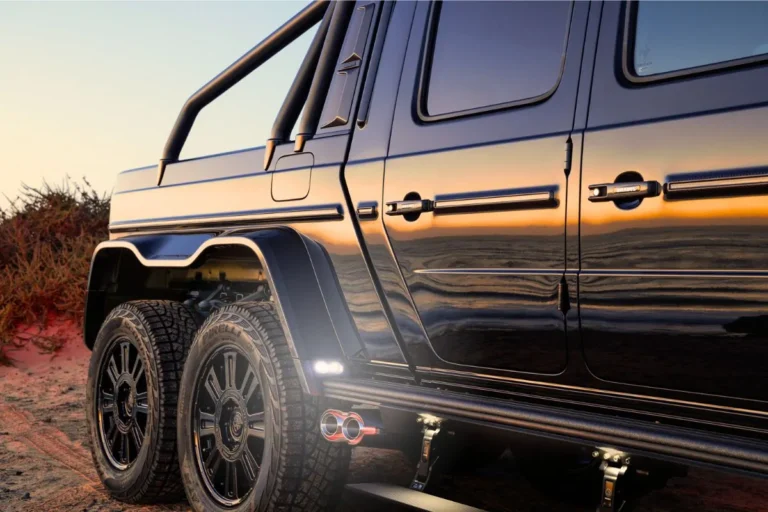
Let’s take a few seconds to count all the wheels… 6, all-wheel drive, but is it really just a simple 4×4 with an extra axle?

The original work is by Brabus, it’s the XLP 900 6×6, a showcase of refinement, power, and a bit of pollution, although on this front, the manufacturer is one of the few to consider the ecological aspect. Still, the Beast emits 420g of CO2 per kilometer, curious!

You can also read:

A colossus with an exceptional pedigree

The BRABUS XLP 900 6×6 is based on an already highly intense model: the Mercedes-AMG G 63, a legend in the luxury SUV world. However, the work done by Brabus goes far beyond simple customization. As usual, the German tuner has designed this model, refining both the mechanical and aesthetic aspects. First, the G 63’s chassis was extended to accommodate an additional axle, transforming the 4×4 into a 6×6 (six-wheel drive). Then, each component was rethought to meet the demands of this new size, including a raised suspension and transmission systems tailored to the 6×6 configuration. Beyond its oversized dimensions, the XLP 900 6×6 embodies Brabus’ philosophy: pushing the limits of both aesthetics and technology. The vehicle becomes as much a showcase of craftsmanship as a coveted object reserved for the wealthiest. With its limited production, it continues Brabus’ tradition of rarity.

President Trump bought this Ferrari in 2007, and now it’s up for sale in what already appears to be the auction of the year

The superblack as a mechanical work of art

It’s hard to ignore the imposing presence of the XLP 900 6×6 Superblack when you cross paths with it. You can’t miss its matte black body with carbon fiber inserts. The widened bumpers and reinforced side protections add to its aggressive dimension, while the 6 22-inch wheels equipped with all-terrain tires emphasize the effect. Brabus designers have ensured that every line and curve expresses both power and elegance. The interior of the XLP 900 6×6 is a sanctuary of luxury. Black leather seats, emblazoned with the brand’s B logo, brushed aluminum inserts, and carbon fiber finishes all reflect the vehicle’s dual nature: sportiness and elegance. This level of customization showcases the brand’s expertise: each client can work with Brabus to tailor the interior and features to their needs. From ambient lighting to the configuration of controls, everything can be adjusted, making each XLP 900 6×6 a truly unique model.

Performance that defies gravity

With its 4.5-liter twin-turbo V8 engine, the BRABUS XLP 900 6×6 Superblack delivers an astounding 900 horsepower and 1,250 Nm of torque. These impressive numbers are to be considered in light of its weight of 3.5 tons. Despite this bulk, every acceleration reminds you that this colossus knows no limits. It rockets from 0 to 100 km/h in just 5.2 seconds—an unbelievable feat for such a configuration. To achieve this, the turbos have been optimized, the transmission reinforced, and the exhaust system reimagined to manage the significant thermal flows generated by this monster. The result? A deep, powerful sound that announces the arrival of the XLP 900 long before it’s even visible. To withstand the acceleration and rough terrain, Brabus has installed a raised suspension with adaptive dampers to provide optimal comfort. The high-performance braking system, featuring oversized discs, ensures control in all situations.

A 6×6 bonfiguration built to conquer all terrains

Why opt for a six-wheel drive configuration? Beyond the dramatic effect, the 6×6 offers off-road capabilities that few vehicles can match—at least that’s the promise. With its six-wheel drive, the XLP 900 6×6 ensures optimal traction distribution. Whether climbing, navigating rocky paths, or crossing deserts, this behemoth is ready to take on any challenge, according to the tuner. With its increased ground clearance and reworked approach and departure angles, it remains highly capable (as if we had any doubts) and manages to avoid obstacles that could prove costly. The specially chosen tires offer exceptional grip in varied conditions, from muddy trails to desert dunes. Reinforced axles and adaptive differential systems guarantee impressive maneuverability despite the vehicle’s size and weight. But let’s be honest, it’s not for its off-road capabilities that you choose this beast! You choose it because it’s a symbol of exclusivity. Owning a 6×6 means showcasing the ability to exceed automotive market standards and access a world reserved for a select few (over one million euros plus a €60,000 environmental penalty in France in 2024).

No one is buying this Mercedes: only 1,608 sold and a massive urgent problem to fix

This article focuses on the BRABUS XLP 900 6×6 Superblack model, an impressive machine blending luxury, power, and off-road capability. It highlights its exceptional technical assets, but also its limitations, such as its high price and significant environmental impact. A true masterpiece, its price makes it a vehicle reserved for an elite group of enthusiasts.

Source : Brabus

Commercial flop or revolution? Sony and Honda team up to launch their first electric car, already highly controversial

With the Afeela 1, Sony and Honda are making an ambitious entry into the premium electric vehicle market.

However, despite years of development, this model raises questions about its positioning in a market already dominated by established competitors. With its high price tag, underwhelming performance, and promise of cutting-edge technology, the Afeela 1 seems to be navigating uncertain waters.

Read more:

Performance that fails to impress

From the outset, the Afeela 1 faced high expectations. With an estimated range of 323 miles for its top-tier version, it falls well short of rivals like the Tesla Model 3 Long Range, which offers 391 miles and costs $40,000 less. The charging situation isn’t much better: capped at 150 kW, the Afeela takes up to 40 minutes to recover 186 miles of range—twice the time of some competitors. Under the hood, the Afeela 1 features dual electric motors delivering a combined 490 hp, powered by a 91 kWh battery. While these figures aren’t bad, they don’t compensate for its technical shortcomings, including a 400V architecture that lags behind more advanced 800V systems found in models like the Porsche Taycan or Lucid Air.

Estimated range of 323 miles for its top-tier version - © Afeela
Estimated range of 323 miles for its top-tier version – © Afeela

A premium positioning that raises eyebrows

Sony and Honda are marketing the Afeela 1 as a premium sedan with a “harmonious and timeless” design and an interior focused on entertainment. The cabin impresses with its dashboard-spanning digital display and 28 speakers for an immersive sound experience. However, at nearly $100,000 for the high-end version, the investment might seem excessive compared to competitors like Tesla, Porsche, or even Hyundai, which offer a better balance of technology and performance at more competitive prices. Sony seems to be leveraging its reputation in the tech industry to attract customers with an advanced multimedia system. But it remains to be seen whether these features can justify such a steep price, especially in a segment where expectations for range and charging capabilities are high.

Sony and Honda are marketing the Afeela 1 as a premium sedan - © Afeela
Sony and Honda are marketing the Afeela 1 as a premium sedan – © Afeela

An unclear strategy

Produced in Ohio and expected to hit U.S. roads in 2026, the Afeela 1 will need to prove itself quickly in an already saturated market. Promises of a “unified” driving experience and advanced autonomous capabilities supported by 40 sensors and onboard AI might attract tech enthusiasts. However, these features may not be enough to offset outdated technical specs and an uncompetitive price. Sony and Honda’s ambitions bring to mind past missteps, like the DeLorean DMC-12. While its design and gadgets were impressive, its performance fell short. History could repeat itself with the Afeela 1 unless it finds a way to stand out in this challenging market.

This article explores the challenges faced by the Afeela 1, the first electric car from Sony and Honda, in a segment dominated by more advanced and competitively positioned models. With questionable performance, a high price tag, and ambitious technology, this vehicle sparks as much curiosity as skepticism.

Is Porsche fragile? Yet this iconic model has proven its robustness on the worst roads by traveling 19,900 miles

Images: © Afeela

Is Porsche fragile? Yet this iconic model has proven its robustness on the worst roads by traveling 19,900 miles

When we talk about the Porsche 911 Dakar, we often picture a supercar reserved for a select few, safely tucked away in luxurious heated garages.

However, a Vietnamese owner has shattered this stereotype by taking the car where it truly shines: extreme terrains for which it was designed. His incredible road trip across Asia proves that this special edition is not just a collector’s piece but a true adventure vehicle.

Read more:

An adventure off the beaten path

Nguyen Hoang Anh, the first owner of a Porsche 911 992 Dakar in Vietnam, wasted no time testing the limits of his car. As soon as he got the keys to his silver Dakar, he embarked on an extraordinary journey. In September 2023, accompanied by two friends, he set off from Ho Chi Minh City to traverse Laos, China, and even the heights of Tibet. His goal? To take his Porsche on roads where no other 911 had ever ventured. Over a journey spanning more than 19,900 miles, Nguyen explored landscapes ranging from the Gobi Desert to the snow-capped mountains of Pakistan, reaching altitudes of up to 4,500 meters (approximately 14,765 feet). While snow and rocky trails posed significant challenges, the 911 Dakar 992 proved it was far more than just a luxury toy. Even when sharp stones in Mongolia shredded its tires, the driver was well-prepared with spare solutions. The result was an epic road trip that showcased the full versatility of this one-of-a-kind supercar.

Nguyen Hoang Anh, the first owner of a Porsche 911 992 Dakar in Vietnam

A Porsche built for extreme terrain

Unlike other 911 Dakars that spend more time posing for photos than covering miles, Nguyen’s was used exactly as Porsche intended. This limited edition model, capped at 2,500 units, was designed to tackle rugged terrain while maintaining the iconic performance of the 911. With a starting price exceeding $250,000, the car features raised suspension, off-road tires, and a design inspired by legendary rally cars of the 1980s. For Nguyen, this was more than a trip—it was a statement. Every kilometer driven and every photo captured in remote locations demonstrated that the 911 Dakar is far more than an expensive indulgence. It can compete with SUVs and pickups while retaining the DNA of a pure sports car. Its performance under extreme conditions, from -13°F to +95°F, proved that this Porsche is as tough as it is refined.

Extreme conditions, from -13°F to +95°F, proved that this Porsche is as tough as it is refined.

A one-of-a-kind road trip

While many 911 Dakar owners limit their cars to smooth roads to protect their investment, Nguyen took a different path. Returning to Ho Chi Minh City in December 2023 after three months of adventures, his Porsche had covered more miles than most other models in this limited series will in a decade. Reaching destinations as varied as the Tibetan Plateau and Russia’s frozen borders, Nguyen proved that the spirit of adventure is alive and well in this Porsche.

President Trump bought this Ferrari in 2007, and now it’s up for sale in what already appears to be the auction of the year

This article explores how a passionate owner unlocked the full potential of the Porsche 911 Dakar on a 19,900-miles journey, conquering extreme terrains and harsh climates. This journey stands as a testament to Porsche’s engineering and the spirit of adventure this supercar embodies.

President Trump bought this Ferrari in 2007, and now it’s up for sale in what already appears to be the auction of the year

A Ferrari F430 once owned by Donald Trump is heading to auction, and the excitement surrounding this sale continues to grow.

This 2007 model, linked to one of the most controversial U.S. presidents in history, is expected to attract collectors eager for a piece of history and an exceptional automobile. With such provenance, one question remains: how high will the bids go?

Read more:

A Ferrari like no other

At first glance, this Ferrari F430 appears to be a classic piece for fans of Italian sports cars. Finished in the iconic Rosso Corsa red and powered by a naturally aspirated 4.3-liter V8 engine producing 490 horsepower, this car represents the golden age of Ferrari engines without hybrid assistance or turbocharging. However, what truly sets it apart is its pedigree: this F430 was purchased new by Donald Trump in 2007. Since then, it has been meticulously maintained, with just 9,394 miles on the odometer. Accompanied by its original accessories, including a Ferrari-branded car cover and documents bearing Trump’s name, this F430 has been showcased at several prestigious events, including at Mar-a-Lago, Trump’s famous Florida estate. While standard Ferrari F430s typically sell for $130,000 to $160,000 depending on mileage, its association with the former president could easily double or even triple its value.

This F430 was purchased new by Donald Trump in 2007 - © Rockstar Car Auction
This F430 was purchased new by Donald Trump in 2007 – © Rockstar Car Auction

Politics driving car values

This isn’t the first time a vehicle owned by Trump has attracted significant attention from collectors. Last year, a Lamborghini Diablo VT Roadster from his personal collection sold for $1.1 million, nearly double its usual value. With Trump’s popularity continuing to grow, especially after his return to the political arena, this Ferrari is poised to set a new record. The car’s connection to American political history might appeal to a wider audience beyond automotive enthusiasts. Pieces like this become emotional investments for those who admire Trump or for anyone looking to own a fragment of contemporary history. Documents such as the original title signed by Trump and carefully preserved accessories add cultural and historical significance to an already extraordinary car.

With Trump’s popularity continuing to grow, this Ferrari is poised to set a new record - © Rockstar Car Auction
With Trump’s popularity continuing to grow, this Ferrari is poised to set a new record – © Rockstar Car Auction

A sale sparking debate

The auction of this Ferrari is being organized by Rockstar Car Auction and will run from February 16 to March 9, 2025. While the idea of owning a car tied to a former president is alluring, it’s likely to spark differing opinions. Some may view it as a symbol of opulence, while others might associate it with a polarizing political figure. Regardless, the F430 is far more than just a car. With its timeless design, impressive performance, and direct connection to an iconic figure, it is set to be one of the most publicized lots of the year. Collectors should be prepared to dig deep into their wallets, as bids are likely to exceed all expectations.

This article explores the auction of a Ferrari F430 once owned by Donald Trump and how its unique provenance could make it a treasure for car enthusiasts and history buffs alike. Blending political heritage with automotive prestige, this sale promises to make headlines and push the boundaries of the auction market.

“Say goodbye to boring cars” – Ford announces a complete shift in strategy to focus on a segment already iconic in the U.S.

Source & more images: Rockstar Car Auction