Home Blog Page 9

The drivers are fed up! After F1, it’s rally’s turn to lead the fight against the FIA and its controversial penalty system

0

After the Formula 1 drivers, it’s now the WRC drivers who are angry with the FIA: a fine that pushed things over the edge.

Tensions between the FIA and rally drivers have reached a new level. Following the controversial fine imposed on Adrien Fourmaux during the Rally of Sweden, the entire WRC driver group has stepped up. In a joint statement, they denounce what they consider excessive penalties and call for greater transparency regarding the money collected by the FIA. This protest echoes the recent positions taken by Formula 1 drivers, who are also tired of the harshness of the new disciplinary rules.

Read more:

The FIA fine that doesn’t sit well

It all started with a simple phrase spoken by Adrien Fourmaux at the end of a difficult special stage in Sweden: “We screwed up.” A casual comment? Not for the FIA, which fined him €10,000, with an additional €20,000 suspended in case of a repeat offense. This sanction, based on a rule prohibiting remarks deemed “inappropriate,” caught everyone off guard. In the heat of the moment, after hours of battling snow and extreme conditions, expecting drivers to have perfectly measured words seems unrealistic.

Reactions were swift. The World Rally Drivers Alliance (WoRDA), which represents WRC drivers and co-drivers, released a statement demanding explanations. The biggest concern is the size of the fines, which are considered disproportionate compared to the earnings of rally drivers, which are much lower than those in F1.

Adrien Fourmaux - © Jaanus Ree - Red Bull Content pool
Adrien Fourmaux – © Jaanus Ree – Red Bull Content pool

A discontent that goes beyond rallying

This outcry from WRC drivers echoes that of the Formula 1 drivers, who previously demanded explanations about how the funds collected from fines were used. At that time, FIA President Mohammed Ben Sulayem simply replied that it wasn’t their problem—a response that convinced no one and only deepened the distrust toward the governing body. Rally drivers now want immediate clarifications. To them, these penalties give the impression that the FIA is trying to fill its coffers at their expense, without anyone knowing exactly where that money goes Rallying is a demanding sport with long days, extreme conditions, and constant concentration. In that context, expecting drivers to maintain perfect emotional control after hours of racing seems unrealistic.

Mohammed Ben Sulayem - © FIA Press Conference
Mohammed Ben Sulayem – © FIA Press Conference

A growing protest in motorsports

In their statement, the drivers do not dispute the need for a certain disciplinary framework, but they are concerned about the trend of imposing heavier penalties for insignificant details. They highlight several key points:

  • Adrenaline and fatigue make it difficult to have completely controlled speech after a special stage.
  • Cultural and language differences can sometimes affect the interpretation of remarks.
  • Rallying is an extreme sport where drivers constantly push their limits.

Beyond this frustration with fines, the very image of the sport is at stake. The drivers worry about the message being sent to fans: should interviews be sanitized and lose the rawness that gives rally its charm? The drivers are now demanding a direct meeting with the FIA to find a solution. It remains to be seen whether the governing body will agree to listen to these demands or choose, once again, to ignore the grumbling.

This article explores the protest by the WRC drivers against the FIA following the fine imposed on Adrien Fourmaux, draws parallels with the situation in F1, and highlights the drivers’ concerns about the management of penalties and the funds collected.

Images: © Red Bull Content pool

Not before 2035! Japan is preparing tomorrow’s world for the Electric Vehicle, but we’ll have to wait to see batteries double their range

“Revolutionizing electric vehicles: next-gen solid-state batteries could double driving range.

In a ground-breaking advancement, a research team, including Kyoto University and Toyota Motor Corporation, has unveiled a new solid-state battery technology that promises to significantly enhance the performance of electric vehicles (EVs) by potentially doubling their driving range by 2035.

You can also read:

A leap in battery technology

Traditional batteries function through ions moving back and forth between positive and negative electrodes. Typically, lithium-ion batteries can release only one electron per atom, but the newly developed “copper nitride” positive electrode material allows for the extraction of three electrons per nitrogen atom. This breakthrough triples the capacity per volume compared to current lithium-ion batteries and doubles the capacity by weight.

The science of copper nitride

The key to this innovative advancement is the utilization of nitrogen within the electrode’s reaction with fluoride ions. This interaction enables the extraction of multiple electrons from each atom of nitrogen, significantly increasing both the storage capacity and energy density of the batteries. Professor Yoshiharu Uchimoto of Kyoto University points out the novelty of using negative ions such as nitrogen in battery reactions, highlighting its scientific fascination.

Solid-state batteries: a new era

This development is part of the broader shift towards solid-state batteries, which are known for their improved performance over conventional lithium-ion options. The complete assembly of these batteries requires not just the innovative positive electrode but also a new type of negative electrode and a solid electrolyte. Research efforts are ongoing to optimize these components for future applications.

A fully solid fluorescent-light battery integrates new electrical currents. This is what Kentaro Yamamoto, research director and associate professor at Nara Women's University (who was also an associate professor at Kyoto University at the time of the research), stated.
A fully solid fluorescent-light battery integrates new electrical currents. This is what Kentaro Yamamoto, research director and associate professor at Nara Women’s University (who was also an associate professor at Kyoto University at the time of the research), stated.

Implications for electric vehicles

The implications of this technology are profound for the electric vehicle industry. The use of these new solid-state batteries could increase the driving range of EVs from an average of 375 miles to about 750 miles on a single charge. This enhancement addresses one of the major limitations of current EV technology—range anxiety—and could significantly boost consumer adoption of electric vehicles.

Collaborative research and development

The research was a collaborative effort involving multiple prestigious institutions, including Tokyo University, Hyogo University, Tohoku University, and Tokyo University of Science, in addition to Kyoto University and Toyota. The findings were published in the respected Journal of the American Chemical Society, marking a significant milestone in battery technology research.

Future outlook

Looking ahead, the researchers aim to commercialize this technology for use in electric vehicles by 2035. As development progresses, the potential for these batteries to transform the electric vehicle market is immense, promising a future where EVs can drive longer distances with shorter charging times, making them more practical for everyday use and long-distance travel.

This new solid-state battery technology not only signifies a major leap forward in energy storage solutions but also marks a significant step towards sustainable and efficient electric vehicle technology that could revolutionize the automotive industry.

Source: J. Am. Chem. Soc. 2025, 147, 7, 5649–5657

https://doi.org/10.1021/jacs.4c12391

Bugatti vs. Koenigsegg: The ultimate drag race between the world’s two fastest cars—and their 2,880 hp—was decided by mere inches

Bugatti vs Koenigsegg: In your opinion, which of these two hypercars wins?

We’ve seen plenty of drag races on YouTube. But here, Carwow and Mat Watson have taken competition to another level. When two $5 million hypercars face off in the Abu Dhabi desert, it takes on a whole different dimension. Bugatti Chiron Super Sport versus Koenigsegg Jesko Attack, with about 2,900 horsepower at the start line… and a result that was much closer than expected.

Read more:

Insane power, two opposing philosophies

On one side, the Bugatti Chiron Super Sport, driven by Mat Watson and the successor to the legendary Veyron, is designed to shatter straight-line speed records. In fact, its evolution, the Super Sport 300+, holds the record at over 304 mph. Under the hood, it features an 8.0-liter quadriturbo W16, developing 1,600 horsepower and 1,600 Nm of torque. The power is delivered to all four wheels thanks to a 7-speed dual-clutch automatic transmission, allowing it to crush the asphalt from the start. Its only real drawback? Its weight—1,995 kg (4,398 lbs) on the scale.

Facing it is the Koenigsegg Jesko Attack, a car designed primarily for the track. Although it is less powerful in its standard configuration (1,280 horsepower for 1,000 Nm of torque with its 5.0-liter twin-turbo V8), it makes up for it with an ultra-light construction: only 1,420 kg (3,130 lbs). Unlike the Bugatti, it is rear-wheel drive, which complicates a standing start. But once launched, its power-to-weight ratio and aerodynamics work in its favor.

Bugatti Chiron Super Sport - © Carwow on YouTube
Bugatti Chiron Super Sport – © Carwow on YouTube

A duel closer than expected between the Chiron SS and the Jesko

In the first run, as expected, the Bugatti gets off the line faster, benefiting from its all-wheel drive to grip the road better. Meanwhile, the Jesko struggles to transfer its power to the rear wheels and quickly falls behind. But on the second attempt, everything changes. This time, the two cars start perfectly together and remain side by side until the finish line. At this level of performance, every detail counts: the Bugatti wins by just a few centimeters, even though both complete the quarter-mile in 9.6 seconds flat. An almost perfect tie that proves the Jesko has nothing to envy when it comes to pure acceleration. Perhaps the closest finish Carwow has ever seen!

In the third round, with a standing start on a half-mile, the advantage shifts once again to the Bugatti. With more downforce and better stability, it even exceeds 190 mph without shaking. But in the fourth attempt, plot twist! This time, the Jesko takes over, benefiting from a poor gear ratio engagement on the Bugatti at the start. Proving that even a hypercar can make a mistake.

Koenigsegg Jesko Attack - © Carwow on YouTube
Koenigsegg Jesko Attack – © Carwow on YouTube

Impressive braking and a battle of passion

The final test: braking. Starting at 150 km/h (93.29 mph), the two monsters must come to a stop as quickly as possible. And once again, the Bugatti prevails, stopping in a shorter distance despite its extra 575 kg (1,268 lbs). In the end, the Chiron Super Sport wins the duel, thanks to its better traction off the line and more effective braking. But the Jesko did not fall short, proving that a well-exploited lightweight can rival a monstrous all-wheel-drive system. Beyond the numbers, this duel will be remembered as a clash between two extreme visions of performance—a Bugatti built for pure speed, a Koenigsegg designed for track adrenaline… and one lucky owner who has the chance to own both… Please, check out their video!

This article explores the drag race showdown between the Bugatti Chiron Super Sport and the Koenigsegg Jesko Attack, the difference in philosophy between these two hypercars, and the intensity of the duel that was decided by mere centimeters.

Images: © Carwow on YouTube

We were lied to! Forget the Aston Martin DB5 and DBS—this Bentley was the real James Bond car

James Bond would have loved this one-of-a-kind Bentley, and it’s finally real…

When people talk about James Bond’s cars, everyone immediately thinks of the Aston Martin DB5—an icon of the 007 films, or even the more recent DBS and DB10 seen in Casino Royale and Spectre. Yet in Ian Fleming’s novels, the secret agent primarily drove a Bentley, notably a certain “Locomotive,” a completely fictional model. That is, until a passionate fan decided to recreate it in real life.

Read more:

A Bentley straight out of a novel

It was while reading Ian Fleming’s meticulous descriptions that Tony Hunter, an automotive designer and huge James Bond fan, had a somewhat crazy idea: to bring the Bentley “Locomotive” to life. In the novels, this car is supposed to be a one-of-a-kind model—a modified Bentley Continental purchased by Bond after an accident left it in ruins. To build this car born from Fleming’s imagination, Hunter chose a 1953 Bentley Continental R-Type as the base. The project was supposed to take 18 months… but it eventually took seven years. However, the effort was worth it: every detail was designed to perfectly capture the universe of the world’s most famous spy. Under the hood, you’ll find a fully restored 4.9-liter inline-six from the Bentley S1. To make the car as effective as Bond himself, a second fuel tank was added, allowing it to cover long distances without stopping.

To build this car born from Fleming's imagination, Hunter chose a 1953 Bentley Continental R-Type as the base.
To build this car born from Fleming’s imagination, Hunter chose a 1953 Bentley Continental R-Type as the base.

Gadgets worthy of 007

A James Bond car without gadgets is like a Martini without vodka. So, Tony Hunter made sure to add a few surprises inspired by the films and books. Behind the grille? A secret compartment. On the dashboard? Switches to activate fake machine guns, a smoke machine, and a device to spread oil on the road to throw off potential pursuers. And because James Bond remains a gentleman, a drawer hidden under the dashboard holds a flask and some mysterious pills—a detail that would surely have made Ian Fleming smile. The onboard phone is another incredible nod: Hunter found an authentic handset from a 1950s RAF bomber, which he connected to an iPhone hidden under the center console. A subtle touch of modernity, integrated without compromising the spirit of the car.

On the dashboard? Switches to activate fake machine guns, a smoke machine, and a device to spread oil on the road.

A car built to drive, not to sit in a garage

Unlike movie cars that are often limited to static appearances, this Bentley Locomotive is fully functional and meant to be driven. Tony Hunter has no intention of letting it gather dust. His goal? To take it out on the road, especially across Europe, just as Bond would. Kudos to him—it’s a fantastic project, whether you’re a car fan or a movie buff! With a style inspired by the 1950s, an elegant body, and an engine ready to devour miles, this one-of-a-kind Bentley is a true declaration of love for the James Bond universe.

This Bentley Locomotive is fully functional and meant to be driven.

This article explores the bold recreation of the Bentley Locomotive, inspired by the James Bond novels, the 007-worthy gadgets integrated into the car, and its ambition to hit the roads around the world.

New Lamborghini model? The legendary V10 supercar is finally making a comeback for just 77 die-hard purists—and it’s going to cost a fortune

This Lamborghini Gallardo restomod with 600 hp costs more than a new supercar… But it’s powered by a V10 !

The Lamborghini Gallardo has never left the hearts of enthusiasts, and it seems that some have decided to give it a second life. Tedson Motors, a Croatian company specializing in restomods, has unveiled the Etna, a completely revamped version of the Gallardo, featuring a reworked naturally aspirated V10, a finely tuned chassis, and a carbon fiber body. The only catch: this rebirth comes at a price of €750,000…(nearly $785,000) not including the donor car.

Read more:

A V10 Lamborghini comeback

While Lamborghini has officially moved on from the V10 with its new hybrid Temerario, some nostalgic fans refuse to see this legendary engine disappear. Tedson Motors took a Gallardo base and completely reconditioned it to turn it into a true modern missile. Under the hood, you find the 5.0-liter naturally aspirated V10, but it’s been entirely reworked: 600 hp and a redline raised to 10,000 rpm thanks to a new intake, a titanium exhaust, and optimized internal components. A pure homage to the supercars of the past, without hybridization or forced induction—just raw, expressive mechanics. In the end, you better understand the name “Etna,” which is probably a nod to the Sicilian volcano. Another detail that will please purists is a manual “grid” gearbox, to recapture the brand’s original DNA. Tedson Motors also plans to convert some Gallardos equipped with the robotic E-Gear transmission into full-manual versions.

Etna restomod - © Tedson Motors
Etna restomod – © Tedson Motors

A radical weight reduction for maximum thrills

The Etna doesn’t just boost its engine—it has also undergone an impressive weight reduction. Thanks to the extensive use of carbon fiber, it loses 440 lbs compared to the original Gallardo, weighing around 2,645 lbs. The chassis has also been optimized, with track widths widened by 2.36-inch, a suspension inspired by the Super Trofeo and GT3 versions, and custom 19-inch wheels designed by AL13 Wheels. The goal? To provide a driving experience as radical as possible, with significantly improved grip and agility. Inside, the cabin remains true to the minimalist and sporty spirit of the project: ultra-light bucket seats, high-end materials, and ergonomics designed for intensive use both on road and track.

Etna restomod - © Tedson Motors
Etna restomod – © Tedson Motors

An ultra-limited production and stratospheric price

Tedson Motors plans to produce only 77 examples of the Etna, including 9 launch editions delivered as early as fall 2026. The remaining 68 will be built at a rate of one per month, with each car requiring 12 months of work. But the price might put off many: €750,000 in EU… (about $785,000) not including the base Gallardo, which costs around $100,000 for a low-mileage model. In other words, you must first buy a used Gallardo and then hand it over to Tedson for transformation. Is it really worth it when more modern alternatives, like the Lamborghini Huracán STO, are available for a much lower price? For purists, the answer is probably yes: no modern supercar offers a V10 as wild, with a manual transmission and such a radical philosophy. This is a true collector’s item, and you can trust Tedson Motors—they’ve already done an amazing restomod on a Porsche 911!

Etna restomod - © Tedson Motors
Etna restomod – © Tedson Motors

This article explores Tedson Motors’ bold project to reinvent the Lamborghini Gallardo with the Etna—a 600 hp restomod that is lightweight and designed for purists, its exorbitant price, and its positioning against modern supercars.

Source & images: Tedson Motors

This $4M Ferrari hypercar completes the insanely crazy collection of the world’s most famous—and probably richest—chef

Gordon Ramsay is cruising around London in a $4 million Ferrari Daytona SP3… and putting on a show as usual!

When you’re a global superstar, riding in a supercar or hypercar is almost a given. And when your name is Gordon Ramsay and you have a fortune estimated at several hundred million, you don’t drive an “ordinary” car. The famous British chef, known for his fiery outbursts both in the kitchen and on TV, was spotted in the streets of London behind the wheel of a Ferrari Daytona SP3, a rare gem valued at over $4 million, during a special occasion: the launch event for the 2025 Formula 1 season, F1-75 Live.

Read more:

A noticed appearance in an ultra-exclusive Ferrari

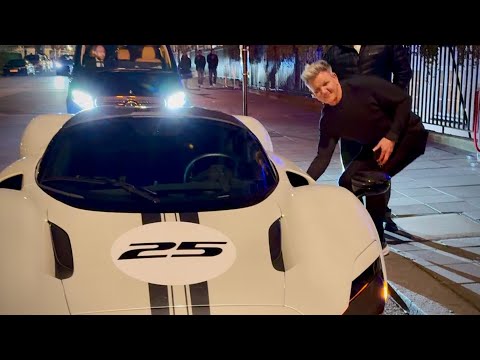
Gordon Ramsay doesn’t just cook Michelin-starred dishes; he also collects exceptional cars. Among his many Ferraris, the Daytona SP3 is probably one of the most impressive. Produced in only 599 units, this hypercar pays homage to 1960s race prototypes and stands out with its 6.5-liter naturally aspirated V12 producing 828 horsepower. Launched at full power, it goes from 0 to 60 mph in 2.86 seconds and can reach 124 mph in 7.4 seconds—performance worthy of a race car, yet combined with the luxury and exclusivity of a Ferrari crafted for the most discerning collectors. For his London appearance, Ramsay opted for a customized model with a Bianco Cervino paint and a blue Alcantara interior—a choice that is both elegant and aggressive, perfectly matching his personality. With the stripes and 25 numbers on the bodywork, this SP3 looks like a real racing car!

Gordon Ramsay's Ferrari Daytona SP3
Gordon Ramsay’s Ferrari Daytona SP3

A Ferrari fan who doesn’t hide his passion

While some people buy supercars to let them sit in a garage, that’s clearly not the case for Gordon Ramsay. He actually drives his machines, not just for public appearances. The chef owns an impressive collection of Ferraris, including a LaFerrari Aperta, a Monza SP2, and an F12tdf. But he doesn’t stop at Ferrari—he also owns McLarens, Aston Martins with a Valiant, a Porsche, and even a BAC Mono. A collection that would make any automotive enthusiast green with envy. And, as is often the case, Ramsay isn’t one to keep a low profile. At the F1-75 Live event—a celebration dedicated to Formula 1—he once again left a strong impression, not only by arriving behind the wheel of his Daytona SP3 but also by dropping a cheeky, censored remark live, true to his legendary bluntness.

London transformed into an F1 paddock for one evening

The F1-75 Live event held in London attracted numerous personalities from the motorsports world. Alongside Gordon Ramsay, all the current Formula 1 drivers were present, as well as figures like Mika Hakkinen, Christian Horner, and even Bernie Ecclestone. It was a true meeting of legends where supercars and F1 greats converged in a unique atmosphere. Seeing a Ferrari Daytona SP3 cruising the streets of London is a spectacle in itself. But with VIPs, drivers, and passionate fans present, this event turned the British capital into a true automotive temple.

This article explores Gordon Ramsay’s appearance behind the wheel of his Ferrari Daytona SP3 in the streets of London, his impressive car collection, and the exclusive atmosphere of the F1-75 Live event.

Images: Reddit

Why spend so little? With a starting price of $140,400, the Porsche 911 is the best-selling car in this ultra-rich country

In most countries, the best-selling cars are usually affordable and practical models like the Toyota Corolla or the Volkswagen Golf.

But in 2024, a small state nestled between Spain and France completely upended this logic. In Andorra, the Porsche 911 became the best-selling car, ahead of much more accessible models. A paradox? Not really, when you consider the tax and economic specifics of this territory where luxury is almost the norm.

Read more:

A market dominated by prestige

Andorra, with its 81,000 inhabitants and favorable tax system, is an ideal playground for sports car enthusiasts. In 2024, 83 Porsche 911s were registered in the principality—a striking number when you know that only 2,379 new vehicles were sold in the country overall. In other words, one out of every 29 new cars was a 911. Why such enthusiasm for this model? Part of the answer lies in the Andorran tax regime, which applies much lower taxes than its French and Spanish neighbors. This makes luxury cars much more accessible. For example, a Porsche 911 is sold there starting at $140,400, a price far more competitive than elsewhere in Europe. But beyond the financial aspect, Andorra’s winding mountain roads are also the perfect playground for a car as balanced and high-performing as the 911. With its rear-mid engine and exemplary handling, it finds ideal conditions to shine.

Why so few? This extreme version of the Mazda MX-5 is finally unveiled, but no one will be able to buy it unless demand skyrockets

The Porsche 911: A symbol of status

While the Toyota GR Yaris ranks second in sales (47 units sold), Porsche’s domination doesn’t stop there. Other models from the brand, such as the Cayenne and the Macan, are also among Andorra’s best-sellers. Owning a Porsche, especially a 911, has become a status symbol in this principality where the standard of living is high. Unlike large European cities, where compact cars and mainstream SUVs dominate, Andorra clearly favors premium and sports cars. And when you consider the countless variants of the model—Targa, Carrera, Turbo, GT3…—the number of 911s can quickly add up!

In Andorra, the Porsche 911 became the best-selling car - © Porsche
In Andorra, the Porsche 911 became the best-selling car – © Porsche

A paradise for enthusiasts of fine machinery

Andorra is often associated with winter sports and duty-free shopping, but it could very well become a new sanctuary for luxury car enthusiasts. With its tax advantages, roads perfectly suited for sports cars, and a wealthy local clientele, all the elements are in place to make this small principality a haven for fans of fine machinery. It is not uncommon to see French or Spanish buyers come to Andorra to purchase vehicles before bringing them back to their home countries. Some also take advantage of the favorable tax rates on parts and labor to carry out maintenance and repairs at a lower cost. With such a marked trend, Andorra could well continue to be a unique case in Europe in terms of car sales. So if you ever visit, don’t be surprised to see more Porsche 911s than compact cars.

This article explores the reasons why the Porsche 911 became the best-selling car in Andorra in 2024, the tax advantages that attract buyers, and the impact of this trend on the local automotive market.

Images: © Porsche

Only one in the world! Maserati was planning to unveil a new convertible, but this custom model has completely overshadowed it

Maserati took advantage of the prestigious International Concours of Elegance (The ICE) in St. Moritz to unveil a more accessible version of the GranCabrio, as well as a one-of-a-kind, custom-built model.

With its 490-horsepower V6 engine and performance worthy of modern grand touring, this new variant is already set to captivate enthusiasts of sporty convertibles. But the real star of the show was undoubtedly the GranCabrio Trofeo ONE of ONE – THE ICE, a custom-built model with icy finishes, designed specifically for this exceptional event.

Read more:

A more accessible, yet still high-performing GranCabrio

Until now, the Maserati GranCabrio was only available in the Trofeo version, boasting 550 horsepower. Now, the trident brand is offering a “more restrained” version (everything is relative) with 490 horsepower, which is the same power as the standard version of the GranTurismo coupe. This 3.0-liter twin-turbo V6 is paired with an all-wheel-drive system and an 8-speed automatic transmission, enabling a 0-60 mph time of 3.9 seconds and a top speed of 188 mph.

Visually, this entry-level version retains the elegant and aggressive lines that make the GranCabrio so charming. Presented at The ICE in a stunning Verde Giada hue, it rides on 20-inch Crio diamond-cut wheels at the front and 21-inch at the rear, complemented by black brake calipers. Inside, the cabin remains just as luxurious, featuring perforated leather seats, a 12.2-inch digital instrument cluster, a 12.3-inch multimedia screen, and a second 8.8-inch screen dedicated to passenger comfort.

Grancabrio 490 cv ICE St Moritz - © Maserati
Grancabrio 490 cv ICE St Moritz – © Maserati

A unique model inspired by winter landscapes

Alongside this new version, Maserati unveiled a one-of-a-kind model: the GranCabrio Trofeo ONE of ONE – THE ICE. Designed by the Fuoriserie department, which specializes in custom-built personalization, this edition pays homage to the snowy landscapes of St. Moritz and the icy ambiance of the event. It sports an exclusive Ice Liquid tri-coat paint—a pearlescent, three-layer hue that recalls the reflections of a frozen lake. Gloss White details contrast with the body, while the forged Astreo design wheels feature brilliant blue brake calipers. The Marine Blue soft top completes the ensemble, giving the car an unmistakably elegant and wintry look. Inside, the icy ambiance continues with a dedicated upholstery that combines cool tones and carbon fiber inserts.

Under the hood, no compromises are made: this edition is based on the Trofeo version of the Nettuno V6, producing 550 horsepower and 650 Nm of torque. The result is a 0-60 km/h time of 3.6 seconds and a top speed of 196 mph.

Grancabrio 490 cv ICE St Moritz - © Maserati
Grancabrio 490 cv ICE St Moritz – © Maserati

Maserati range in full evolution

Beyond these two new models, Maserati is announcing several updates for its GT lineup. The color palette is expanding to offer more options to customers, while the Trofeo versions (both coupe and convertible) will receive a new sport exhaust system as early as March. Maserati promises a purer, even more emotional sound to captivate those who seek thrilling sensations with every acceleration. With this new GranCabrio and a unique model that elevates both luxury and performance, Maserati continues to assert its identity in the grand touring segment. It offers enthusiasts models that are as elegant as they are powerful, whether they are looking for a more accessible GT or a truly exceptional piece.

$3M for this American hypercar: He gets one of only 12 in the world and shows us how to unleash its 1800 hp

This article explores the launch of the 490-hp Maserati GranCabrio, the details of the unique ONE of ONE – THE ICE model, and the announced updates for the Italian brand’s GT range.

Source: Maserati

This Japanese giant unveils an engine that is neither electric nor gasoline-powered and will be the most efficient ever launched in mass production with 59.8% efficiency

Redefining hydrogen fuel: A leap toward sustainable mobility.

At the 23rd International Hydrogen & Fuel Cell Expo in Tokyo, Honda introduced a groundbreaking advancement in hydrogen fuel cell technology. This innovation promises to revolutionize the automotive industry, enhancing the utility and affordability of clean energy vehicles.

You can also read:

A new era of independence

Honda’s new fuel cell module marks a significant shift in its development strategy. Unlike previous models co-produced with General Motors, Honda has taken the reins on this project, developing the technology entirely in-house. This strategic pivot not only emphasizes Honda’s commitment to renewable energy but also positions the company as a leader in fuel cell innovation.

Cost and durability: a dual advantage

One of the standout features of Honda’s new fuel cell module is its cost-efficiency. Production costs have been slashed by 50% compared to earlier models, making this technology more accessible than ever before. In addition, the module’s durability has seen a remarkable improvement, doubling its lifespan and reducing the frequency and cost of maintenance.

Compact powerhouse

Honda has dramatically enhanced the power density of its fuel cell module, tripling it in this latest iteration. This enhancement has allowed for a more compact design, measuring only 28.7 inches in width, 27.5 inches in height, and 22.8 inches in depth. Weighing in at 550 pounds, the new design facilitates easier integration into various applications—from vehicles to stationary power systems, thus broadening the technology’s usability.

Performance and expansion plans

The module’s operational efficiency peaks at an impressive 59.8%, with the capability to function in extreme temperatures ranging from -22°F to 140°F and altitudes up to 11,500 feet. Honda is initially targeting the California market, with plans to equip 300 CR-V vehicles with this technology, thanks to the state’s developed hydrogen infrastructure. However, the company is also looking to expand the technology’s applications and geographic availability, underscoring its commitment to a sustainable energy future.

Beyond vehicles: Honda’s fuel cell generator

Alongside the fuel cell module, Honda unveiled its new Fuel Cell Generator, designed as a reliable and environmentally friendly emergency power source for large facilities. This generator can produce up to 250 kW of power, with the possibility of linking multiple units for over 1,000 kW capacity, all while maintaining zero emissions.

Global context and future horizons

Honda’s advancements are part of a broader surge in fuel cell research globally. For instance, Toyota has recently introduced its third-generation fuel cell system, aiming for enhanced durability and increased range. Meanwhile, Japanese researchers are making strides in materials science that could further optimize fuel cell efficiency. These developments are critical as the industry faces challenges such as the closure of hydrogen fuel stations, underscoring the need for continued innovation and infrastructure development.

Honda next generation fuel cell module specifications

Maximum Output (Net) 150 kW
Output Voltage 450 – 850 V
Maximum Efficiency (Net) 59.8 %
FC Refrigerant Honda Genuine FC refrigerant
Hydrogen Gas Composition Equivalent to ISO 14687
Low Voltage Power Supply DC24V
Module Dimensions DC24V W730 x D580 x H700 mm
Volume ・ Volumetric Density 300 L ・ 0.50 kW/L
Weight ・ Weight Density 250 kg ・ 0.60 kW/kg
Operating Temperature -30℃ – +60℃
Storage Temperature -40℃ – +60℃
Max Altitude 3,500 m
Ingress Protection Rating Equivalent to IP67
CAN Communication Standard ISO11898
Communication Protocol SAE J1939 / Honda Hi-Speed CAN (selectable)
Compatible Communication Speeds 500 kbps


Source: Honda

Millions of dollars saved: Haas F1 Team just narrowly avoided a battle that could have cost them dearly against a Formula 1 star

0

Former Haas F1 Team boss drops his lawsuit after a surprise settlement!

It was expected that the case would drag on for months, but Guenther Steiner and Haas F1 Team have finally reached an agreement. The former head of the American team, ousted in early 2024, had filed a lawsuit against his former employer, claiming that the team owed him money and continued to exploit his image without his consent. After nearly 29 hours of mediation, both parties reached a settlement, putting an end to the conflict once and for all.

Read more:

A legal battle that dragged on

When Steiner learned that his contract would not be renewed, he quickly reacted by filing a lawsuit against Haas F1 last April. His argument? The team built its reputation—especially in the United States—thanks to him, notably through his exposure in the Netflix series Drive to Survive. He also accused Haas of continuing to use his name and image even after he was ousted from his role as team principal. The case quickly drew public attention, with Steiner becoming one of the most iconic figures in the paddock thanks to his frankness and memorable on-camera outbursts. But after several months of tension, the former Haas boss and the American team finally found a compromise that definitively closes the case.

Here’s why the return of the V10 in Formula 1 is impossible today despite the rumors—unless the manufacturers already have a plan

An amicable settlement that buries the case

The mediation, which took place in Mecklenburg County, lasted exactly 28 hours and 36 minutes. At the end of the discussions, Steiner agreed to drop all his allegations and close the case with no possibility of reopening it. Haas quickly released an official statement confirming the resolution of the conflict:

“Haas Formula, LLC is pleased to announce that Guenther Steiner and Haas Formula, LLC have reached an agreement. Guenther Steiner has withdrawn all allegations made in his complaint, and all lawsuits filed against Haas Formula, LLC have been dismissed with prejudice. Both parties wish each other success in their future projects and will make no further comment on the matter.”

This statement marks the definitive end of the litigation between Steiner and Haas, even though the precise reasons for the settlement remain confidential.

This statement marks the definitive end of the litigation between Steiner and Haas.

The contrasting legacy of Steiner at Haas

Steiner took the helm at Haas F1 as early as 2014, two years before the team’s debut in Formula 1. His finest performance was in the 2018 season when the American team secured fifth place in the Constructors’ Championship. But the following years were much more challenging, with plummeting results and two disastrous seasons before his departure. Replaced by Ayao Komatsu in 2024, Steiner left behind a struggling team, but also a huge fan base that he managed to cultivate through Drive to Survive. While Haas is trying to rebuild with an entirely new driver lineup (Esteban Ocon and Oliver Bearman), Steiner himself could well bounce back elsewhere in motorsport. And when you see that Mattia Binotto has returned to the paddock with the Sauber team, why not see Steiner again?

This article explores the end of the litigation between Guenther Steiner and Haas F1, the details of the settlement reached during mediation, and the legacy left by the former boss of the American team.

Images: © Haas F1 Team